The Uechi Ryu style comes from close-quarter survival concepts inherited from southern Chinese systems, especially those associated with Dragon (龍尊拳 - Longzun Quán - Dragon Style), Crane (白鶴拳 - Bái Hè Quán - White Crane Style) and Tiger (虎尊拳 -Huzun Quán - Tiger Style) influences. Therefore Uechi Ryu, compared to longer-range styles, uses tighter guarding structures, more circular trapping motions, shorter striking paths, more emphasis on maintaining center integrity during infighting.
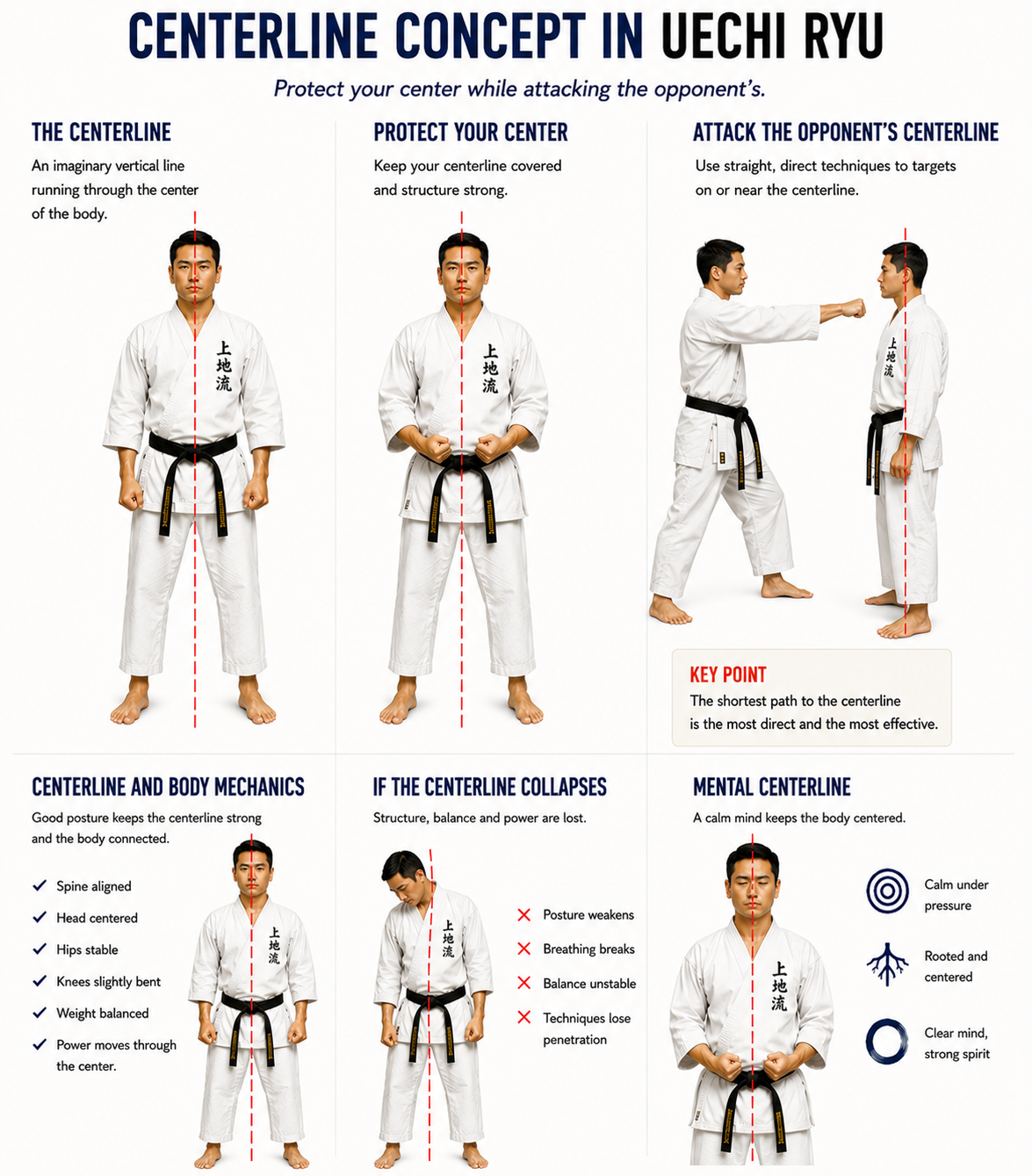
In Uechi Ryu, the concept of the centerline is both physical and strategic. It refers to the imaginary vertical line running through the center of the body — from the top of the head, through the nose, throat, sternum, solar plexus, and groin. But in practice, it means much more than anatomy.
The centerline is key point balancing and mechanics of your body. and tied to posture and power generation. In proper Sanchin kata the spine stays aligned, head centered, hips stable, knees slightly bent, weight balanced. This creates a “one connected body.” Power moves through the center rather than from isolated limbs. When the centerline collapses posture weakens, breathing breaks, balance becomes unstable, techniques lose penetration. This is why Uechi-Ryu places so much emphasis on structure before speed. It explains deep sense of phrase "Everything in Sanchin".
One of major principles in Uechi Ryu is protection your center while attacking the opponent’s. That is why Uechi-Ryu techniques stay compact and close to the body. The elbows remain heavy and inward, shoulders relaxed, and movements economical. In Sanchin kata, the forearms constantly guard the centerline and simultaneously controlling incoming force.
The circular motions of Wa Uke are a good example of deflecting attacks away from the centerline. They re-establish structural dominance over the center and positioning you to counterattack immediately. The centerline is not defended with rigid blocking, but with redirection and structural control.
Most effective targets in Uechi-Ryu, while attacking the opponent’s Centerline, are eyes, nose, throat, solar plexus, groin. This matches the style’s close-range nature. Instead of wide, swinging attacks, Uechi-Ryu favors direct penetration into the opponent’s structure. A straight thrust like: shoken, nukite, boshiken, sanchin thrust often travels directly along the shortest path to the opponent’s center.
At a deeper psychological level, the centerline also reflects mental composure such as remaining calm under pressure, not overcommitting, staying rooted and centered emotionally. Many Okinawan teachers connect this directly to Sanchin training. A practitioner who loses emotional control often physically loses the centerline as well — shoulders rise, posture breaks, breathing becomes chaotic.
In simple terms: The centerline in Uechi-Ryu is the axis of structure, balance, protection, and traget of direct attack.
" Whoever controls the center usually controls the exchange."